Cilincing’s Fishing Children Study Amidst Sweltering Heat
Rabu, 09 September 2026
Pengunggah: Redaksi
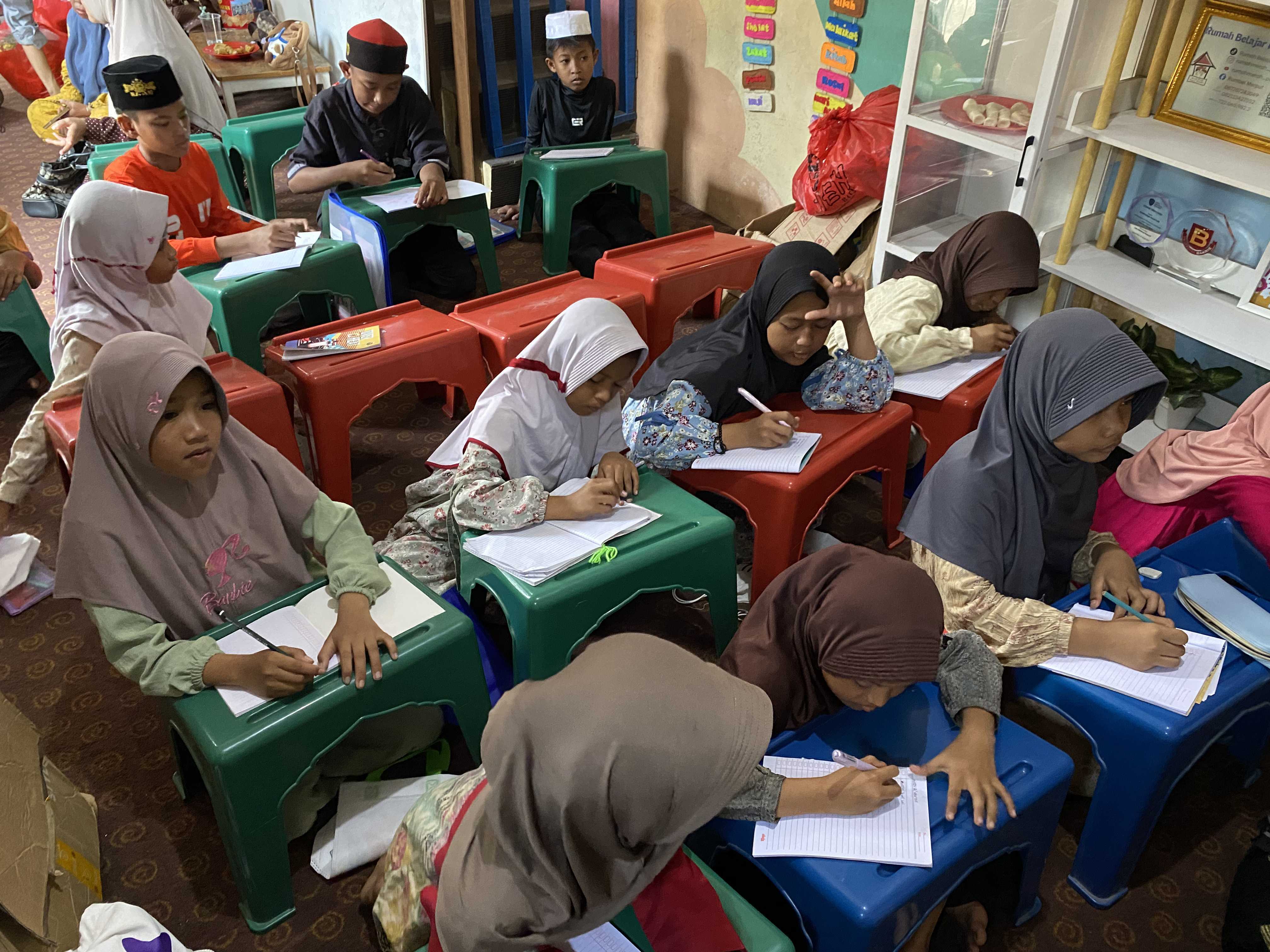
As the weekend begins, children from Kampung Nelayan Kolong Jembatan Cilincing in North Jakarta arrive at Rumah Belajar Merah Putih as usual. By 10 a.m. on August 2, they had filled the empty seats, laid out their stationery, and settled into the 4-by-5-meter classroom.
More than a dozen children sat closely together, with only two fans slowly circulating the air. As the room grew hotter, dust from vehicles crossing the bridge drifted inside. The children wiped sweat from their faces but continued their lessons, counting from 40 to 51 before listening to an English storytelling session.
When class ended, however, they went straight home instead of staying to play. The scorching heat and clouds of dust had become too uncomfortable—a change noticed by the children, teachers, and volunteers.
Their experience reflects a broader challenge as temperatures rise. The National Oceanic and Atmospheric Administration (NOAA) recorded global surface temperatures between January and June at 1.14°C above the 20th-century average, making the period the third-warmest in 177 years.
Heat Takes a Toll on Children’s Concentration
For children, rising temperatures can turn a classroom into a barrier to learning. Save the Children reported that at least 242 million students across 85 countries have experienced education disruptions because of extreme heat, with many schools forced to close. In Indonesia, UNICEF reported in 2024 that at least 15 million children are exposed to heatwaves that can affect concentration and learning performance.
Climate-related disasters pose additional threats. UNICEF data show that 54,080 primary and secondary schools are located in flood-prone areas and another 15,597 in areas vulnerable to landslides. Between 2009 and 2018, 50,666 schools were affected by climate-related disasters.
At Rumah Belajar Merah Putih, the effects are already tangible.
Suryani, a teacher at the center, said children had appeared more exhausted over the past two weeks. Taji, a documentation volunteer, said the heat made them sleepy and less able to concentrate, while dust from heavy vehicles crossing the bridge further aggravated the situation.
“Dust from cars and container trucks comes straight in here, so the children start coughing easily,” Taji said on Sunday, August 2.
Raya, 9, a second-grade student, said the classroom had become increasingly stuffy. She often felt thirsty during lessons and repeatedly went to the kitchen to drink water. Fani, 11, said the heat made it difficult to concentrate.
The discomfort also extends into their homes. Azka, 12, lives directly beside the Cilincing bridge, where vehicle dust reaches his house.
“It’s hot because the bridge is right in front of my house. When the dust blows from the bridge, it comes straight into the front of our house,” Azka said while playing on Sunday.
Enos Ndapareda, Humanitarian Manager at Plan International, said extreme heat can impair concentration, memory, and problem-solving abilities, ultimately affecting children’s academic performance.
“Several studies have shown that high temperatures reduce concentration, memory, problem-solving abilities, and academic performance. Why? Because the room is simply too hot,” he said.
At the learning center, teachers and volunteers provide drinking water and remind children to wash their hands and faces after activities, particularly after exposure to dust.
“Drink more water. Always have water available to drink. And don’t forget to maintain personal hygiene and wash your face. Dust contains a lot of dirt, and we’re worried that it could get into the body,” Taji said.
But the effects of heat and dust do not stop at the classroom. For children living in vulnerable environments, they can also become a health threat.
Health Risks Begin to Threaten Children
A 2021 UNICEF report found that around 600 million children worldwide are vulnerable to vector-borne diseases such as malaria and dengue. Indonesia ranks 46th among countries where children face high risks from the climate crisis. Extreme heat can also contribute to health problems such as kidney disease.
In Jakarta, rising temperatures are compounded by air pollution and flooding. The city’s Environmental Data shows that temperatures in built-up areas have increased by approximately 0.17–0.24°C, indicating a strengthening urban heat island effect. Jakarta has also recorded approximately 997,320 cases of acute respiratory infections (ARI).
In Cilincing, the combination of heat and dust is already affecting children. During the reporting period, AccuWeather recorded a temperature of 33°C, with the feels-like temperature even higher.
Suryani said several of her students had experienced flu, coughing, and fever.
“Some of them have the flu, coughs, runny noses, and even fever. The weather is also very hot,” she said.
Taji has also noticed declining weekend attendance. Classes that once attracted 40 to 50 children now sometimes have fewer than 30.
“When they get sick, some of them don’t come. At first, there could be 40 to 50 children, but now there are fewer than 30 because of the heat and all the dust affecting their breathing,” he said.
The health concerns continue at home. Uun, one of the parents, said her children had recently experienced more frequent coughing, runny noses, and illness. She often bathes them to relieve the heat, but said they sometimes fall sick afterward. When they do, she turns to medicated oil and over-the-counter medicine from a nearby grocery shop.
For families already living with limited resources, these health impacts add another layer of vulnerability. And when livelihoods are threatened, children’s education can become one of the first things families are forced to reconsider.
Layered Vulnerabilities for Girls in Fishing Families
In Cilincing, many families depend on fishing, green mussel shucking, and other informal coastal work. Their livelihoods are highly exposed to weather and sea conditions, leaving little room to absorb additional shocks.
According to WALHI Indonesia, the chairperson of the Indonesian Traditional Fisherfolk Union (KNTI) said extreme weather in January 2026 affected 95% of fishers across 350 coastal villages. Some 63% stopped going to sea because of strong winds and high waves, while daily incomes fell by up to 50%, from Rp400,000–Rp650,000 to Rp200,000–Rp400,000.
Poverty further compounds the pressure. Citing Statistics Indonesia (BPS) data from 2022, WALHI reported that 17.74 million people in coastal areas lived in poverty, including 3.9 million in extreme poverty. This represented 68% of Indonesia’s 26.16 million poor people at the time.
When incomes fall, education can become an expense families struggle to maintain. Enos said girls are particularly vulnerable to being pulled out of school.
“Girls are the ones who are told to stay at home first. ‘Boys, you go to school,’ while girls are told to stay home. Because they think, ‘Well, she’ll get married eventually; she’ll be married off to someone else,’” he said.
Economic hardship can also intersect with child marriage. According to Rumah KitaB, at least 12–20 cases of child marriage were recorded in Cilincing between 2021 and 2023, while Kalibaru recorded 25 cases. Religious Courts Agency (Badilag) data from 2024 recorded 38 marriage-dispensation cases in North Jakarta.
Yet poverty alone does not explain why girls face greater risks. Gender norms also shape who is expected to sacrifice their education or take on greater domestic responsibilities when resources become scarce.
Enos said boys and girls experience climate-related disruptions differently. In communities where patriarchal norms remain strong, girls are often expected to shoulder more domestic and caregiving responsibilities.
Research by the National Commission on Violence Against Women (Komnas Perempuan) and UNFPA in 2023 similarly found that women and girls face layered vulnerabilities during climate crises. As resources become scarce, their domestic and caregiving burdens can increase, further limiting their access to education and other opportunities.
Elaine Enarson, as cited by TRACKSDGs, also notes that poverty, unequal access to resources, and gender norms shape vulnerability to disasters and climate-related crises.
For children in coastal communities, climate resilience therefore means more than surviving extreme weather. It also means ensuring that economic hardship does not determine who stays in school and who is left behind.
Strengthening Protection, from Schools to Communities
As climate impacts intensify, protecting children requires action beyond the classroom. Enos said disaster-management systems must be translated into concrete measures at the provincial, district, village, and community levels, taking into account the different risks faced by each area.
“The approach cannot be one-size-fits-all,” he said.
Policies must also account for groups often overlooked in policymaking, including girls and children with disabilities. Early warning systems, for instance, should be accessible to children with visual or hearing impairments.
Schools also need to be better prepared for rising temperatures and other climate hazards. Enos said standards for school design and ventilation already exist, but the challenge is ensuring their implementation.
In coastal communities, adaptation must address the economic pressures that deepen vulnerability. Diversifying household incomes and strengthening gender-responsive social protection can help families withstand climate shocks without sacrificing children’s education.
At Rumah Belajar Merah Putih, children continue to gather each weekend despite the heat and dust. Their persistence points to a larger challenge: as temperatures rise and climate shocks intensify, keeping children in school will require more than keeping classrooms open.
It will require safe learning spaces, healthier environments, resilient livelihoods, and protection systems that ensure children—especially those already facing layered vulnerabilities—are not forced to pay the highest price for a crisis they did not create.
Penulis : Daffa Ulhaq
Editor : -
Tags
Berita Populer
#1
#2
#3
#4
#5
#6
#7
#8
#9
#10
Berita terkait

Pimpinan Pusat Ikatan Sarjana Nahdlatul Ulama (PP ISNU) memperingati Hari Ulang Tahun ke-26 dengan aksi filantrop...
CommunityKamis, 20 November 2025

Community – Sekelompok pemancing yang tergabung dalam Komunitas Mancing Aceh mengibarkan bendera Merah Putih di...
CommunitySenin, 11 Agustus 2025

Puan Bisa, sebuah komunitas berbasis pemberdayaan perempuan tahun ini kembali melaksanakan Puan Bisa Festival 202...
CommunityRabu, 22 Oktober 2025

Komunitas - Minggu kedua kegiatan akademik di University of California, Riverside (UCR) telah dimulai dengan sema...
CommunitySabtu, 16 Maret 2024

Comunity - Sebagai komunitas yang fokus pada pengembangan diri anak muda, Gensmart Indonesia terus melakukan aks...
CommunitySenin, 15 Juli 2024

Jakarta, 13 Juli 2026 — Sebanyak 1.500 peserta dari berbagai kalangan memadati area Rukun Festival 2026 pada M...
CommunitySelasa, 14 Juli 2026

Community – TEDxBandung 2024 hadir dengan tema “Kiwari”, memberikan refleksi mendalam tentang identitas dan...
CommunityJumat, 13 Desember 2024

Community - Sebagai komunitas yang fokus untuk berdedikasi dalam mendukung dan membimbing para remaja di seluruh ...
CommunitySelasa, 14 Mei 2024

Wacana pemberian makan bergizi gratis (MBG) bagi masyarakat adat Baduy menjadi perhatian publik. Program yang dig...
CommunityKamis, 13 November 2025

Komunitas -Youth Ranger Indonesia (YRI) tidak sekadar sebuah organisasi, melainkan sebuah gerakan yang menginspir...
CommunityRabu, 21 Februari 2024